AI review does not begin after the inspection. It begins when the inspection is captured. Better room order, guided alignment, and clearer baseline photos help before-and-after comparison work more effectively.
AI review starts with better input
Before an AI system can compare move-in and move-out records, the app needs useful visual information. If the original baseline is random, incomplete, or captured from unclear angles, the later review becomes harder.
If the follow-up capture is taken from a very different angle, in a different room order, or without a clear reference, the comparison becomes harder for both the AI and the human reviewer.
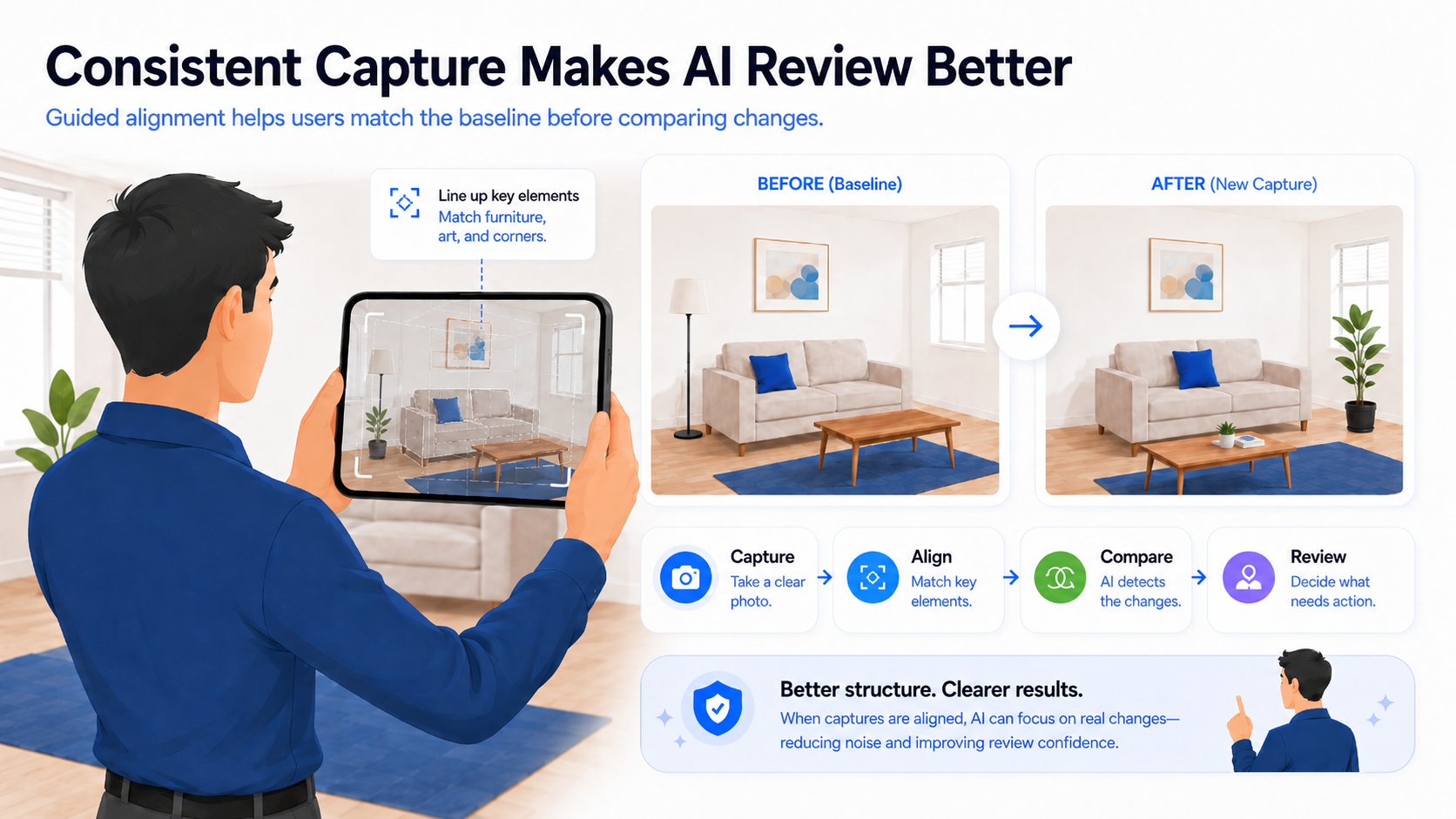
That is why consistent capture matters. PropCheckAI is built around a simple idea: better capture creates a better before-and-after record. Better records make AI-assisted review easier to understand.
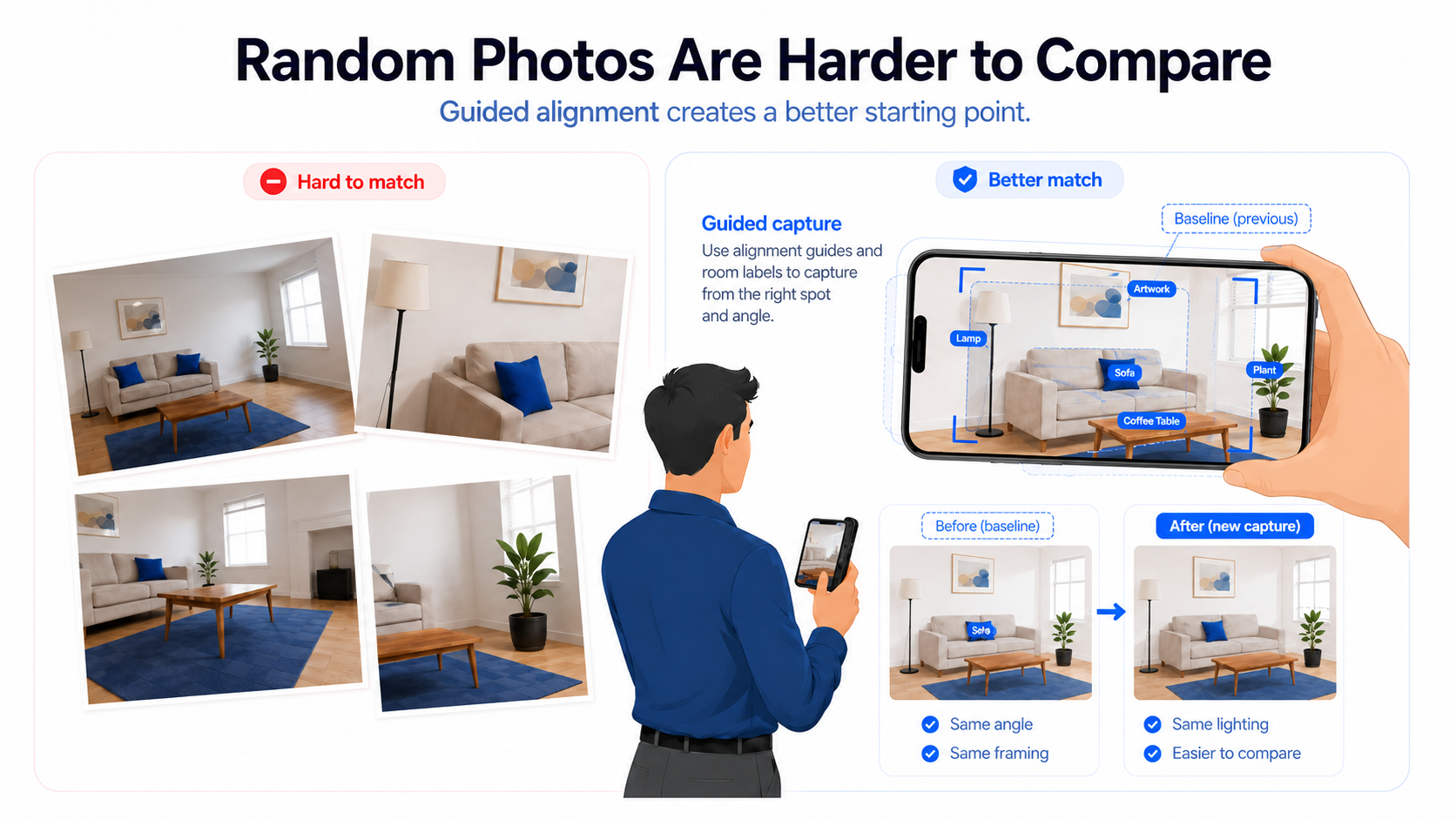
Random photos are harder to compare
Many rental inspections start with good intentions. The landlord takes photos. The renter takes photos. A cleaner sends photos. A staff member captures a few images. But later, the record may be difficult to review because the photos are scattered and inconsistent.
Common problems include:
different room angles
missing room labels
unclear room order
close-up photos without context
wide photos that do not match the baseline
photos taken before cleaning and after cleaning mixed together
images stored in text messages, folders, or email threads
no clear connection between the photo and the final report
Random photos may still be useful, but they are harder to compare. A before-and-after review works best when the images have structure.
The baseline is the foundation
The baseline is the original condition record. For a rental inspection, the baseline may be the master check-in, move-in record, or clean starting condition before a renter begins using the property.
A strong baseline should include:
clear room labels
wide room views
important surfaces
appliances and fixtures
floors and walls
included items
visible existing wear
repeatable capture angles
The baseline does not need to be perfect. But it should be useful. A clear baseline helps the user, the AI-assisted comparison, and the final report.
Follow the same room order
A consistent room order makes every inspection easier to complete and easier to review. For example: entry, living room, kitchen, bathroom, bedroom, then balcony, storage, garage, or outdoor area if needed.
The exact order depends on the property. The important part is repeatability. When the landlord sets the path, renters, staff, or cleaning teams can follow that same path later.
This helps prevent skipped rooms and helps the reviewer understand the record faster.
Guided alignment helps users match the baseline
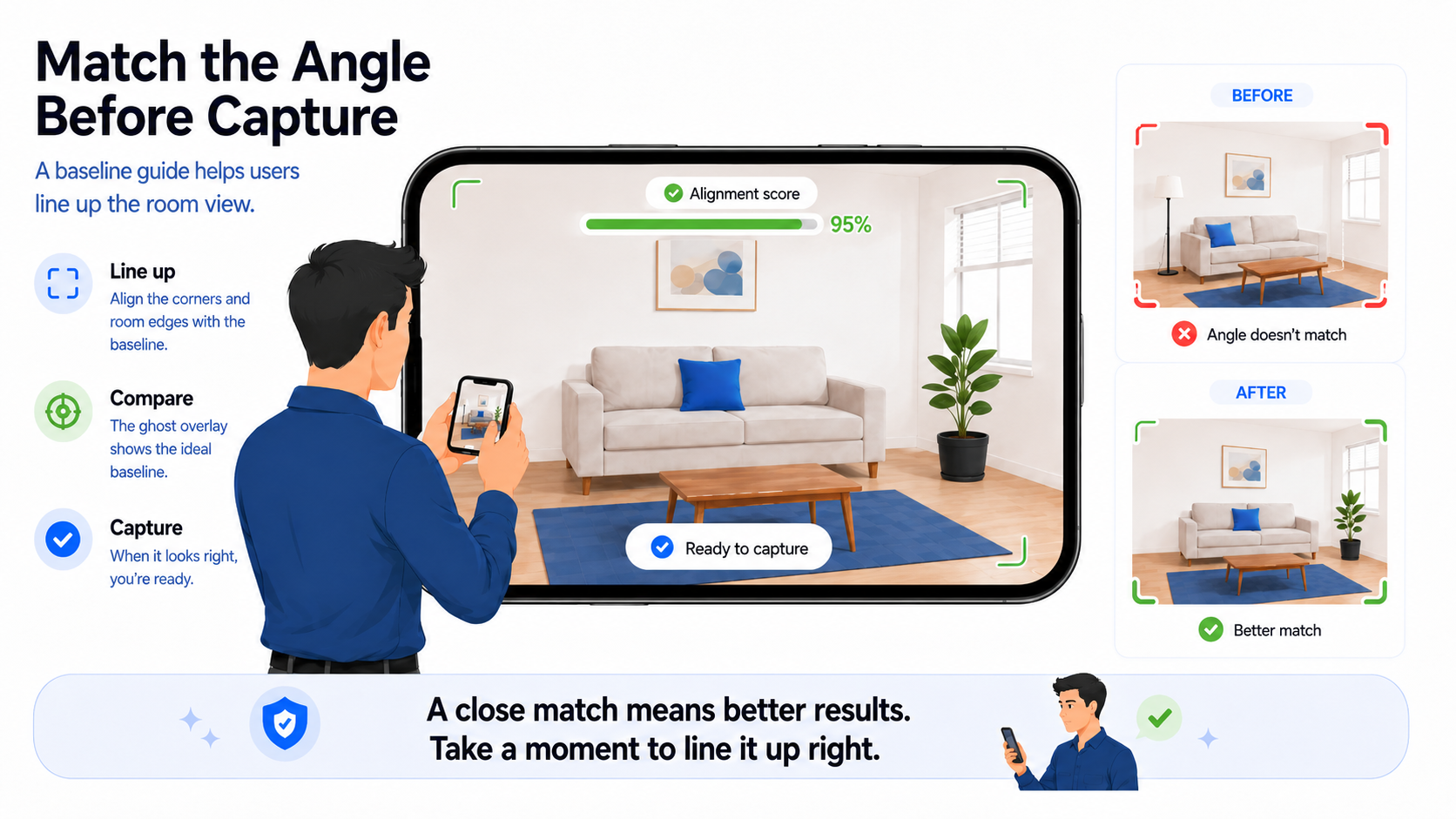
Consistent room order is important, but angle matters too. If the move-in photo was taken from one side of the room and the move-out photo was taken from a completely different angle, the comparison becomes harder.
That is why guided alignment is useful. A guided alignment view can help the user line up a follow-up capture with the previous baseline image. The user can use the old view as a reference and adjust the camera until the new view is close enough to compare.
The goal is not to force a perfect match. The goal is to give the user a better starting point.
Similar angles improve before-and-after review
Before-and-after comparison becomes easier when photos are captured from similar viewpoints. Similar angles can help the user see what stayed the same, what changed position, what appears new, what may be missing, and whether a detection might be caused by camera angle.
Real inspections are not perfect. People are busy, lighting changes, furniture moves, boxes may be present, cleaners may be working, and a renter may capture checkout from a slightly different position. That is normal.
The point is simple: closer angles usually create clearer comparison. Guided alignment helps users get closer.
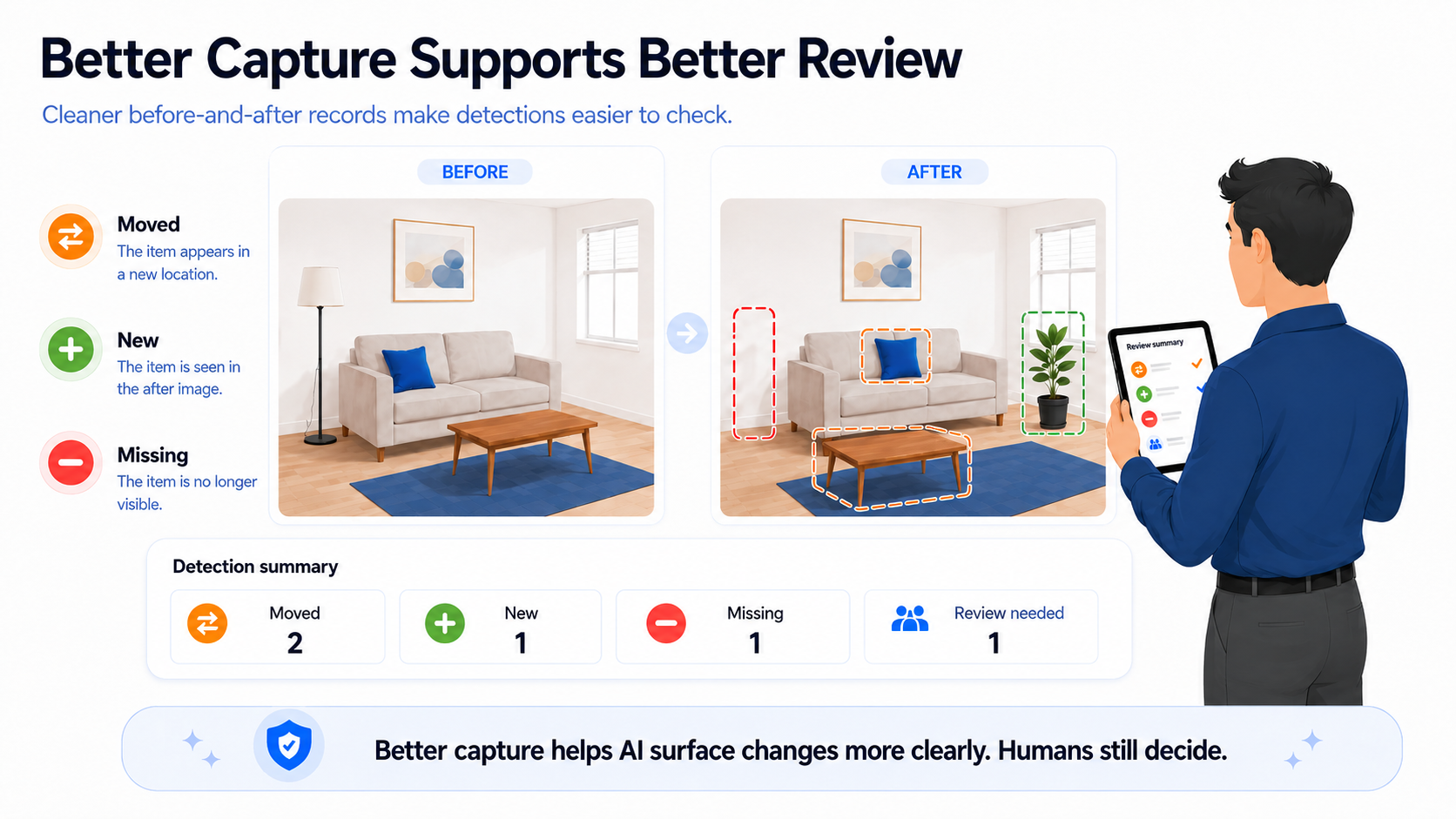
Better capture supports better detections
PropCheckAI uses AI-assisted review to help surface moved, new, and missing detections. Those detections are easier to review when the before-and-after images are captured in a consistent way.
Better capture does not mean the AI is always right. It means the AI and the user have a better visual record to work from.
Better capture helps reduce review noise
When the before-and-after images are very different, some changes may be harder to interpret. The reviewer may need to ask whether a difference is a real change, a different angle, lighting, a shadow, a hidden item, a cropped frame, or a poor capture.
Consistent capture helps reduce this kind of noise. It does not remove all uncertainty, but it gives the reviewer a cleaner starting point.
What users should try to do
Users can improve before-and-after review by following a few simple habits:
use the previous baseline image as a reference
match the room view before capturing
keep the same room order across inspections
capture wide views before detail views
retake blurry or misaligned images
Short factual notes can also help later review. For example: “Cleaner moved table before after-cleaning photo,” “Lighting changed because blinds were open,” or “Lamp removed before checkout review.”
Capture consistency helps delegated inspections
Consistent capture is especially important when more than one person helps. A landlord may capture the baseline. A renter may capture checkout. A staff member may capture follow-up. A cleaning team may capture before and after cleaning.
If everyone captures randomly, the record becomes harder to review. If everyone follows the same structure, the process is stronger. That is why the landlord should define the room order and baseline first, then renters, staff, or cleaners can follow the same process later.
What consistent capture does help with
Consistent capture can help users:
create stronger baseline records
make follow-up inspections easier
reduce random photo confusion
improve before-and-after comparison
support moved, new, and missing detection review
help renters or staff follow the same process
make landlord review faster
create clearer inspection reports
This is why capture quality matters. Not because users need perfect photos. Because better structure helps everything that comes after.
Final takeaway
AI-assisted review is only as useful as the inspection record it is reviewing. That record starts with capture. A clear baseline, repeatable room order, similar angles, and guided alignment help create before-and-after records that are easier to compare.
PropCheckAI helps users move beyond random photos by supporting a more structured capture process. The result is a better starting point for AI-assisted review and human decision-making.
Important Disclaimer
PropCheckAI helps users create, organize, compare, and review rental inspection documentation. PropCheckAI does not provide legal advice, does not guarantee dispute outcomes, and does not make legal or financial decisions for users. Users remain responsible for reviewing inspection results and deciding how reports are used.
Ready to capture inspections that are easier to compare?