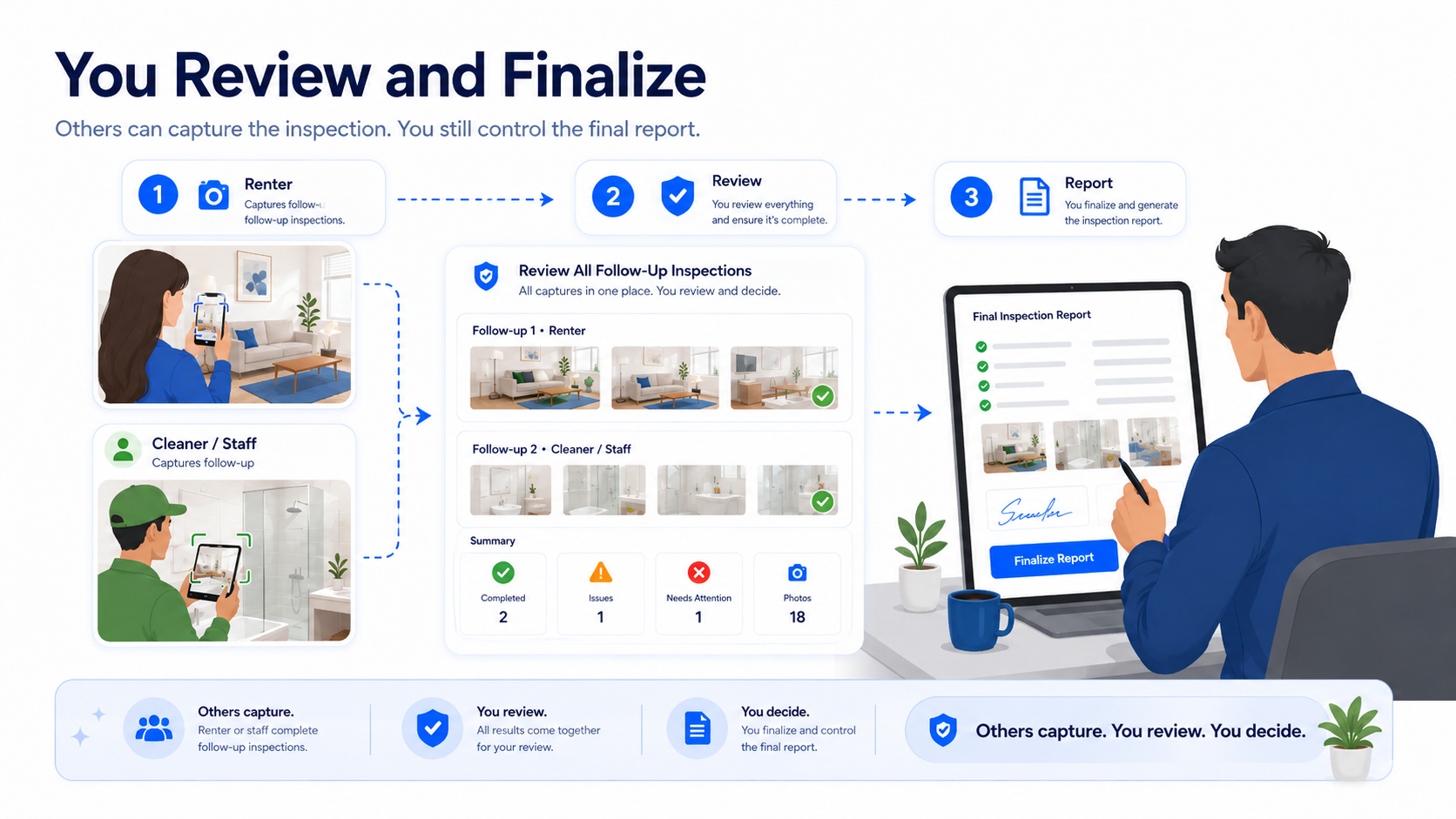
Landlords do not need to capture every follow-up inspection themselves. With the right structure, renters, staff, or cleaning teams can help document the property while the landlord keeps control of review and reporting.
Rental inspections take time
For one property, a landlord may be able to personally handle every move-in, move-out, follow-up, and cleaning check. But as soon as there are more properties, more tenants, more turnover, or more people involved, the process becomes harder to manage.
The landlord cannot always be there. The cleaner may be inside the property first. The renter may be ready to complete checkout before the landlord arrives. A staff member may need to document condition after maintenance.
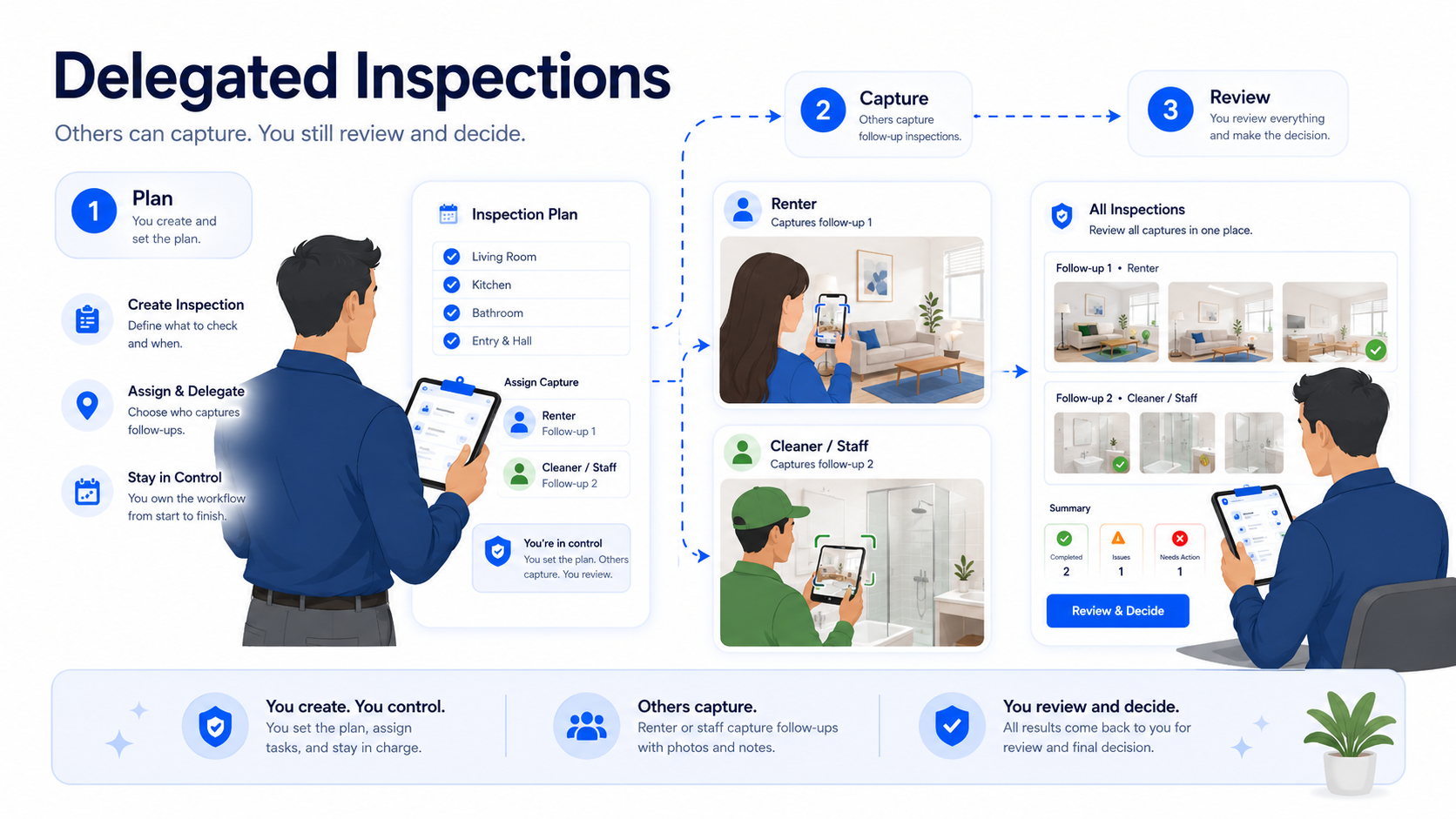
That is why delegated inspections matter. The goal is not to give up control. The goal is to let other people help with capture while the landlord keeps control of the inspection structure, review process, and final report.
PropCheckAI is built around this idea:
Landlord plans the inspection→Renter, staff, or cleaner captures follow-up records→Landlord reviews and decides
Capture can be shared. Control should stay with the landlord.
The problem with landlord-only inspections
Many landlords start with a simple system. They visit the property, take photos, write notes, and save everything somewhere on their phone or computer. That may work when the landlord has one property and enough time.
But landlord-only inspections do not scale well. The landlord has to be physically present for every inspection. They have to remember the room order. They have to capture every photo. They have to review every detail. They have to create the report afterward.
This becomes difficult when the landlord manages multiple properties, tenants move out on short timelines, cleaners enter the property before the landlord, staff members handle turnover work, renters want to document move-out condition, or inspections need to happen when the landlord is unavailable.
The result is often inconsistent documentation. One inspection may be detailed. Another may be rushed. One person may document the kitchen carefully. Another may skip the bathroom. One checkout may include photos. Another may only include a few notes.
The problem is not that people are lazy. The problem is that the process is not structured enough to share.
Delegation only works when the process is clear
Delegating an inspection does not mean telling someone, “Go take some photos.” That creates random documentation.
Good delegation requires structure. The landlord should define which rooms should be captured, what order the rooms should follow, what areas matter in each room, when the inspection should happen, who should capture the follow-up, who reviews the results, and what should be included in the report.
This is what makes delegated inspections useful. The landlord sets the standard. Other people follow the process. The landlord reviews the result.
Start by setting the baseline
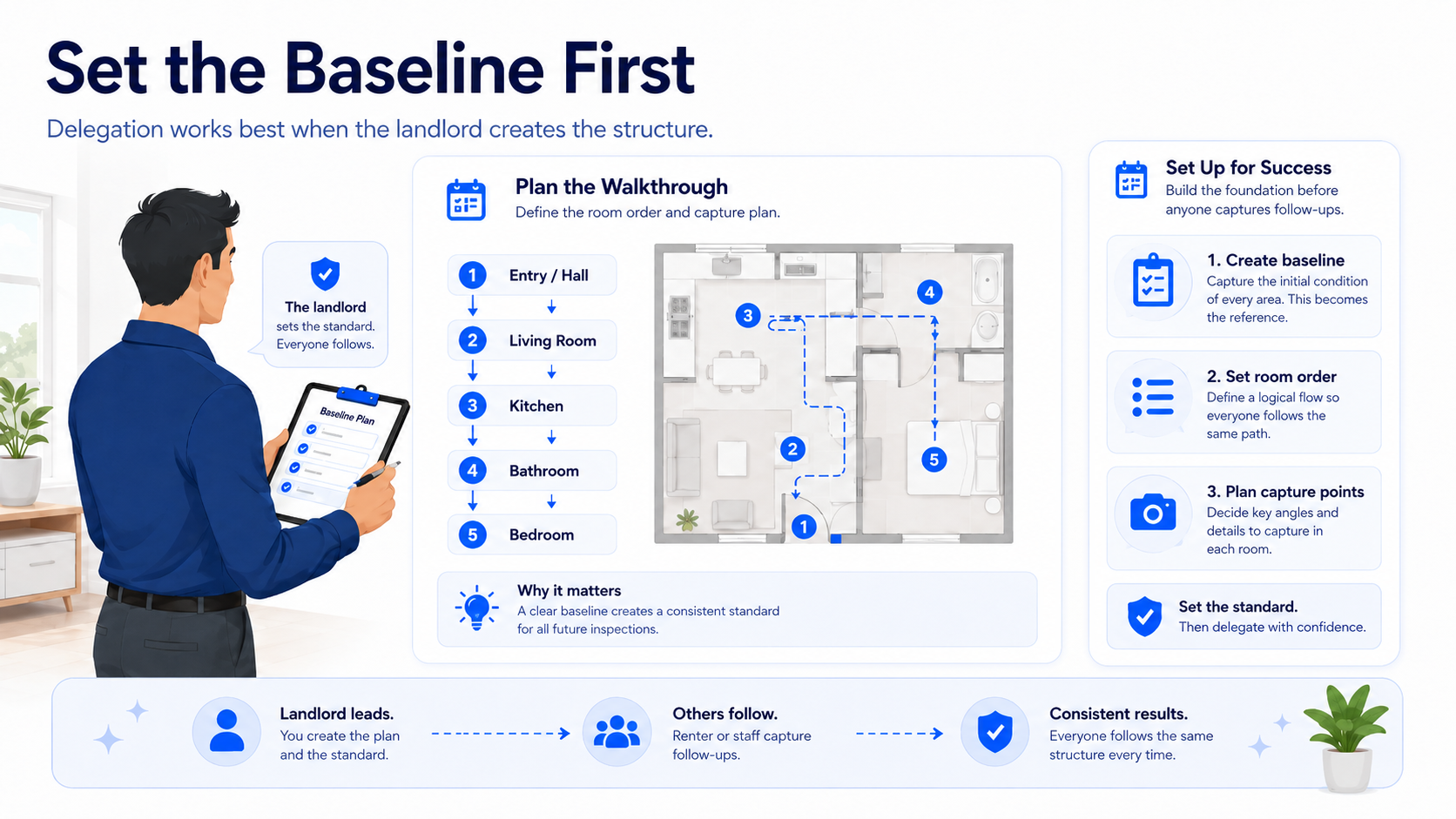
The first inspection should belong to the landlord or the person responsible for defining the property standard. This is the baseline.
The baseline shows the original condition of the property before the tenant begins using it. It also creates the structure that future inspections should follow.
A strong baseline should include:
room order
room labels
important surfaces
appliances and fixtures
furnished items
existing wear or damage
capture points or repeatable angles
enough visual coverage for future comparison
This matters because future inspections are easier when they have something to follow. If the baseline is clear, then renter checkout, staff inspection, and cleaning follow-up all have a reference point.
Without a baseline, delegated capture becomes much weaker.
People may still take photos, but the record will be harder to compare.
The landlord creates the inspection path
A good delegated inspection starts with a planned walkthrough. The landlord should decide the basic path through the property.
For example:
Entry / hallway
Living room
Kitchen
Bathroom
Bedroom
Balcony, garage, storage, or outdoor area
The exact order can change depending on the property. The important part is consistency. When everyone follows the same room order, the inspection becomes easier to complete, easier to review, and easier to compare.
A renter should not have to guess where to start. A cleaner should not have to decide which rooms matter. A staff member should not have to invent a new process. The workflow should guide them.
This is how delegation becomes reliable.
Capture can be delegated to different roles
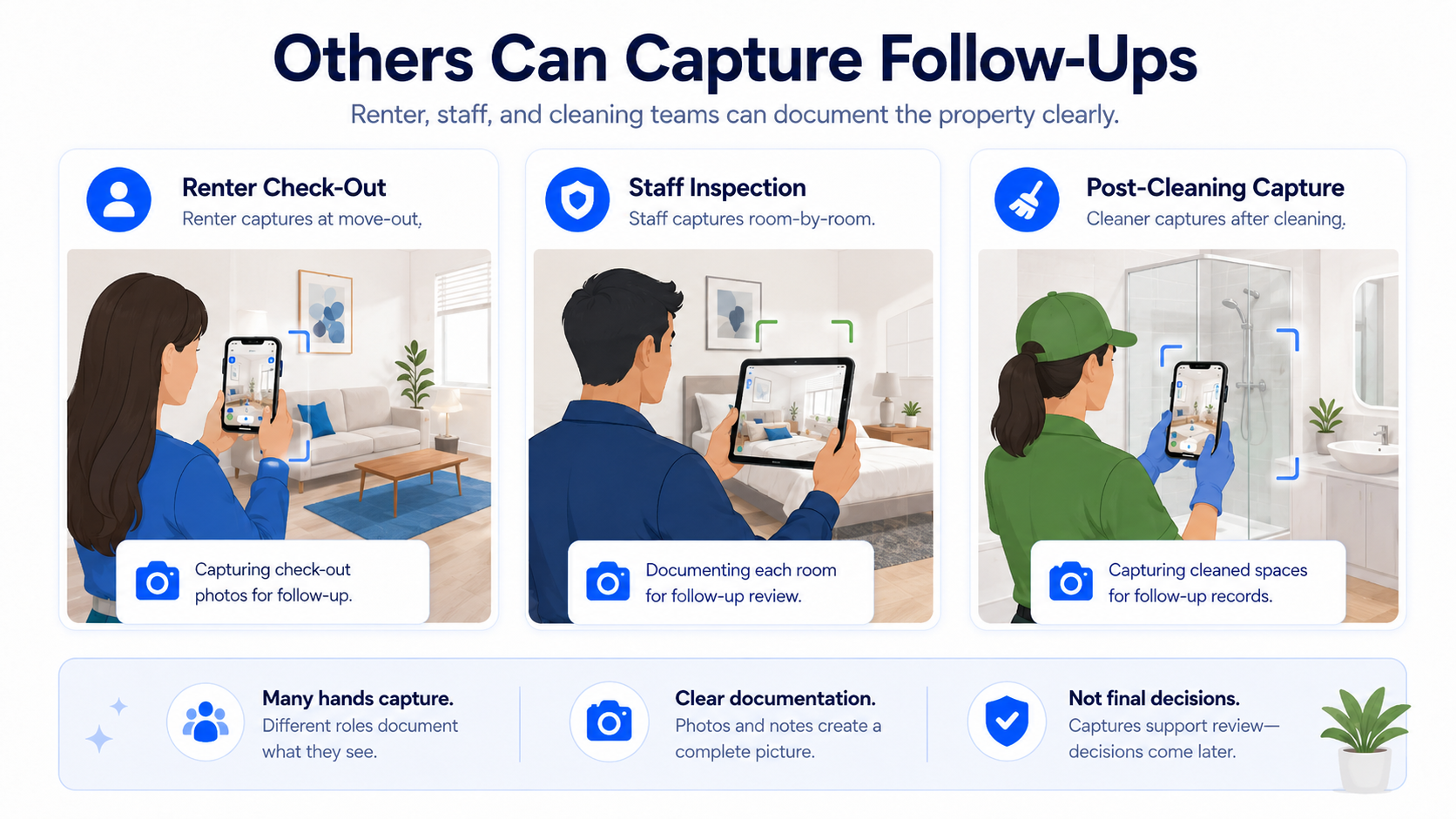
Different people may be involved at different points in the rental lifecycle. A renter may capture move-out condition. A staff member may document repairs or maintenance. A cleaner may capture the property after cleaning. A landlord may review all of it afterward.
Each role has a different job. The key is that capture does not equal final decision. The person capturing the inspection is helping document condition. They are not deciding responsibility. They are not creating legal conclusions. They are not deciding charges.
They are helping create the record. The landlord or responsible reviewer makes the final decision.
Delegated inspections by role
Landlord
Creates the property record, defines the inspection structure, captures or controls the master baseline, reviews results, and generates reports.
Renter
Helps capture renter-side move-in or move-out condition, supporting documentation without replacing landlord review.
Staff
Helps capture property condition before, after, or during turnover work while leaving final comparison and reporting to the landlord.
Admin
Handles higher-level account or system management when needed, without turning every contributor into a final decision-maker.
Renter check-out capture
Renter check-out capture can be useful because the renter is already present at the end of the tenancy. A renter can document the condition of the property before returning keys or leaving the unit.
A good renter check-out should be room-based, guided by the same property structure, factual, timestamped, organized, and easy for the landlord to review.
The renter should not need to know the landlord’s full reporting process. They should simply follow the inspection flow, capture the requested rooms, and add factual notes when needed.
This can reduce confusion because the landlord receives a structured record instead of random photos from a message thread.
Staff inspection capture
Staff members can also help document property condition. This may include property management staff, maintenance workers, assistants, or anyone helping with the turnover process.
Staff capture is useful when the landlord cannot visit the property immediately, maintenance is being completed, a room needs follow-up documentation, someone needs to verify condition after work is finished, or a property manager wants a record before review.
The staff member does not need to make the final decision. They simply capture the room or inspection mode they are responsible for.
This helps create a record that the landlord can review later.
Cleaning company and turnover capture
Cleaning companies often enter the property at an important moment. They may see the condition soon after move-out. They may notice damage, missing items, or unusual condition before or after cleaning. This makes cleaning and turnover teams useful capture helpers.
A cleaner can document condition before cleaning, condition after cleaning, rooms that were completed, areas that still need attention, obvious issues that should be reviewed, and cleaned spaces for follow-up records.
This does not mean the cleaner decides responsibility. It means the cleaner helps document what they see. The landlord can then review the record and decide what matters.
This is a major workflow advantage because the landlord does not have to be the first person inside the property every time.
Delegation keeps the record moving
The biggest advantage of delegated inspections is speed. When only the landlord can capture inspections, everything waits on the landlord. When renters, staff, or cleaners can capture follow-up records, the inspection process can keep moving.
This can help during move-out windows, busy turnover periods, maintenance follow-up, cleaning verification, furnished rental checks, multi-property management, and remote landlord workflows.
The landlord still controls review. But other people help collect the visual record. That is the difference between chaos and a scalable inspection process.
The landlord still reviews everything
Delegation should never mean losing control. The landlord should still review the inspection results before creating a final report.
This matters because captured images may need context. A photo may show something moved. That does not automatically mean damage. A photo may show something missing. That may need explanation. A room may look different because of lighting, cleaning, furniture movement, or normal use.
The landlord or responsible reviewer should decide whether the capture is complete, whether more information is needed, whether a finding matters, whether a note should be added, whether something should be dismissed, and whether the issue belongs in the report.
This keeps the workflow fair and practical. Others capture. The landlord reviews. The landlord decides.
Delegation works best with clear roles
A strong delegated workflow needs role separation. Not everyone should have the same permissions or responsibilities.
That separation allows people to contribute without giving everyone full control. That is how PropCheckAI supports delegation without turning the process into a mess.
Why delegated inspections help landlords scale
Delegated inspections are especially useful for landlords and property managers who want to manage more than one property. Without delegation, the landlord becomes the bottleneck. Every inspection depends on the landlord’s physical presence.
With delegation, the landlord can build a repeatable system: create the property, define the rooms, capture the baseline, set the inspection structure, assign follow-up capture when needed, let renter, staff, or cleaner capture condition, review everything in one place, confirm or dismiss findings, and generate an organized report.
This makes the process easier to repeat. It also makes the inspection record less dependent on memory, text messages, or scattered folders. The landlord does not lose control. The landlord gains leverage.
Why this is better than random photo sharing
Many landlords already ask renters, cleaners, or staff to send photos. The problem is that photos sent through messages are often hard to use later. They may not be labeled. They may arrive out of order. They may be missing rooms. They may be mixed with unrelated messages. They may not connect cleanly to a property, room, inspection type, or report.
A structured delegated inspection workflow is different. The capture is connected to the property. The property is organized by room. The room is connected to the inspection mode. The inspection is connected to review. The review is connected to the report. That connection is what makes the record more useful.
Delegation also helps renters
Delegated inspections are not only helpful for landlords. They can also help renters. A renter check-out gives tenants a clearer way to document move-out condition instead of relying on informal messages or random photos.
This can help reduce confusion because the renter’s capture is organized around the same property structure. A renter can show what the property looked like at checkout, which rooms were captured, when the capture was completed, what notes were added, and what condition was documented before leaving.
This does not guarantee any specific outcome. But it creates a clearer record. Clearer records help both sides understand the condition of the property.
Delegation also helps staff and cleaners
Staff and cleaning teams should not be expected to make final damage decisions. But they are often in the best position to document condition at the right time.
A cleaner may see the property before and after cleaning. A staff member may see the result of a repair. A turnover helper may see missing or moved items during preparation.
With a structured workflow, they can capture what they see without taking on responsibility for final judgment. That is the right balance. Capture is simple. Review is controlled. Reporting is centralized.
The best delegated inspections are simple
A delegated inspection workflow should not be complicated. If the process is too hard, people will skip steps.
The best workflow should make it clear who is capturing, what they are capturing, which room they are in, what inspection mode they are completing, what happens after capture, and who reviews the result.
The capture helper should not need to understand the entire reporting system. They should only need to follow the guided process. The landlord handles the review. This makes the workflow easier to repeat.
What delegated inspections should not do
Delegated inspections should not create confusion about responsibility. A renter, cleaner, or staff member capturing a room should not be presented as the final decision-maker.
Delegated inspections should not claim that the renter approved all findings, the cleaner decided damage responsibility, staff made the legal conclusion, AI automatically proved the claim, or the report guarantees a dispute outcome.
That is not the point. The point is better capture and clearer review.
What delegated inspections do help with
Delegated inspections can help landlords reduce the need to be present for every follow-up, involve renters in checkout documentation, involve staff in turnover documentation, involve cleaners in post-cleaning capture, keep inspection records room-based, review everything in one place, maintain control of final reports, make multi-property workflows easier, reduce scattered photo sharing, and create more consistent documentation.
That makes PropCheckAI more than a photo tool. It becomes a workflow system.
Final takeaway
Landlords should not have to do every inspection capture themselves. But they should still control the inspection process.
That is the power of delegated inspections. The landlord creates the baseline and sets the structure. Renters, staff, or cleaning teams can help capture follow-up records. The landlord reviews the results and decides what belongs in the final report.
Capture can be delegated. Review should stay controlled. That is how landlords can scale inspection workflows without losing oversight.
Important Disclaimer
PropCheckAI helps users create, organize, compare, and review rental inspection documentation. PropCheckAI does not provide legal advice, does not guarantee dispute outcomes, and does not make legal or financial decisions for users. Users remain responsible for reviewing inspection results and deciding how reports are used.
Ready to make follow-up inspections easier to manage?
PropCheckAI helps landlords capture structured inspection records, involve renters or staff when needed, review before-and-after changes, and generate organized inspection reports.